
Opt-Out – One Click Can Lead to Total Loss
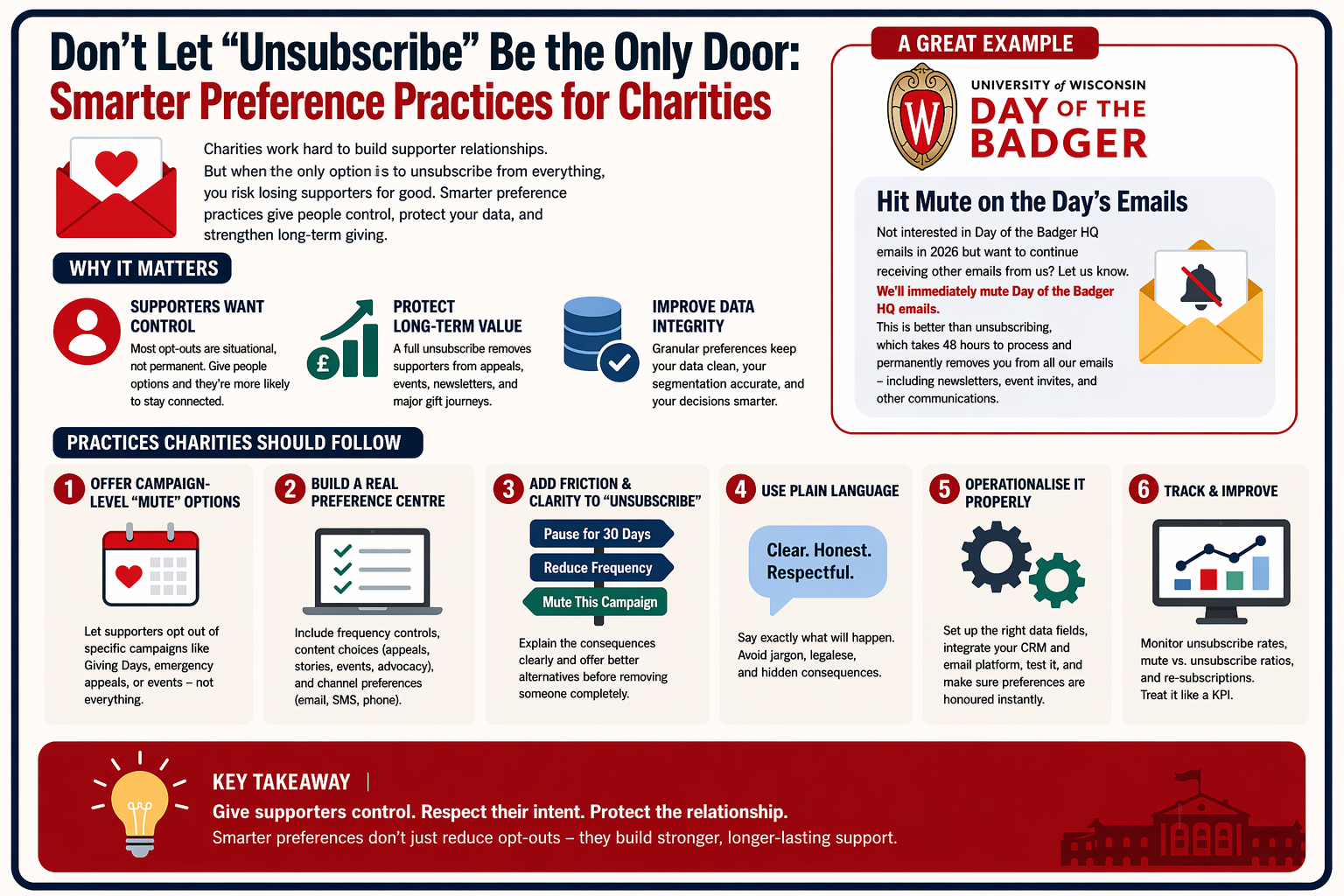
When it comes to opt-out, most organisations still default to an all-or-nothing model:
- Supporters are overwhelmed during campaigns
- They click “unsubscribe”
- You lose them across everything—appeals, stewardship, events, and major gift cultivation
From a governance and revenue perspective, that is poor practice.
It is not that supporters want to disappear. They want control.
A Better Standard: Granular, Campaign-Level Control
A strong example comes from the University of Wisconsin Foundation during its annual giving day, Day of the Badger.
They offer supporters a simple alternative:
“Hit Mute on the Day’s Emails”
Not interested in Day of the Badger emails this year? You can mute just these messages—without unsubscribing from everything else.
They even reinforce the consequence of the wrong choice:
- Unsubscribing removes you permanently from all communications
- Muting is immediate and temporary, preserving the relationship
This is how it should be done—clear, honest, and operationally sound. Kudos to my alma mater!
What This Gets Right (And Why It Matters)
1. It Recognises Supporter Intent
Most opt-outs are situational, not permanent.
- “Too many emails this week” ≠ “I never want to hear from you again”
- Campaign fatigue is real—but temporary
A mute option respects that nuance.
2. It Protects Long-Term Revenue
Every full unsubscribe removes a supporter from:
- Regular giving pipelines
- Major gift cultivation journeys
- Bequest marketing (which relies on long-term engagement)
If you are serious about growth, you cannot afford unnecessary attrition.
3. It Improves Data Integrity
Blanket unsubscribes distort your database:
- Engagement metrics drop artificially
- Segmentation becomes less reliable
- Reacquisition costs increase
Granular preferences keep your data clean and usable.
Practical Steps Charities Should Implement
1. Introduce Campaign-Level “Mute” Options
At a minimum:
- Giving Day emails
- Emergency appeals
- Event-heavy periods
Make it easy to opt out of just that stream.
2. Build a Real Preference Centre (Not a Token Page)
Most preference centres are weak. A proper one includes:
- Email frequency controls (e.g., weekly, monthly)
- Content categories:
- Appeals
- Impact stories
- Events
- Advocacy
- Channel preferences (email, SMS, phone)
If you are utilising Salesforce Marketing Cloud, Microsoft Dynamics 365, or Blackbaud Raiser’s Edge NXT, this is entirely achievable. The limitation is rarely the technology—it is the discipline.
3. Put Friction in the “Unsubscribe All” Path
Do not make it hard—but do make it clear:
- Explain consequences plainly
- Offer alternatives first:
- “Pause for 30 days”
- “Reduce frequency”
- “Mute this campaign”
This alone will materially reduce list attrition.
4. Use Plain Language (Not Legal Language)
The Wisconsin example works because it is:
- Direct
- Honest
- Operationally transparent
Avoid:
- Jargon
- Compliance-heavy wording
- Hidden consequences
Say exactly what will happen.
5. Operationalise It Properly (This Is Where Most Fail)
This is not just a marketing decision—it ia operational.
You need:
- Clear data fields for campaign suppression
- Integration between CRM and email platform
- Governance over how preferences are applied
- Testing before every major campaign
If your systems cannot honour preferences instantly, you will lose trust.
6. Monitor Opt-Out Behaviour Like a KPI
Treat this as a board-level metric:
- Unsubscribe rate by campaign
- “Mute vs unsubscribe” ratio
- Re-subscription rates
If you are not tracking it, you are guessing.
What Happens If You Ignore This
Let’s be blunt.
If you continue with an all-or-nothing unsubscribe model, you will:
- Shrink your file unnecessarily
- Increase acquisition costs
- Weaken long-term fundraising performance
And you will do it to yourself.
Charities often talk about “donor-centricity.” This is where it shows up in practice.
Give supporters opt-out control. Respect their intent. Protect the relationship.
The organisations that do this well will not just reduce opt-outs—they will build stronger, longer, and more valuable supporter relationships over time.
